
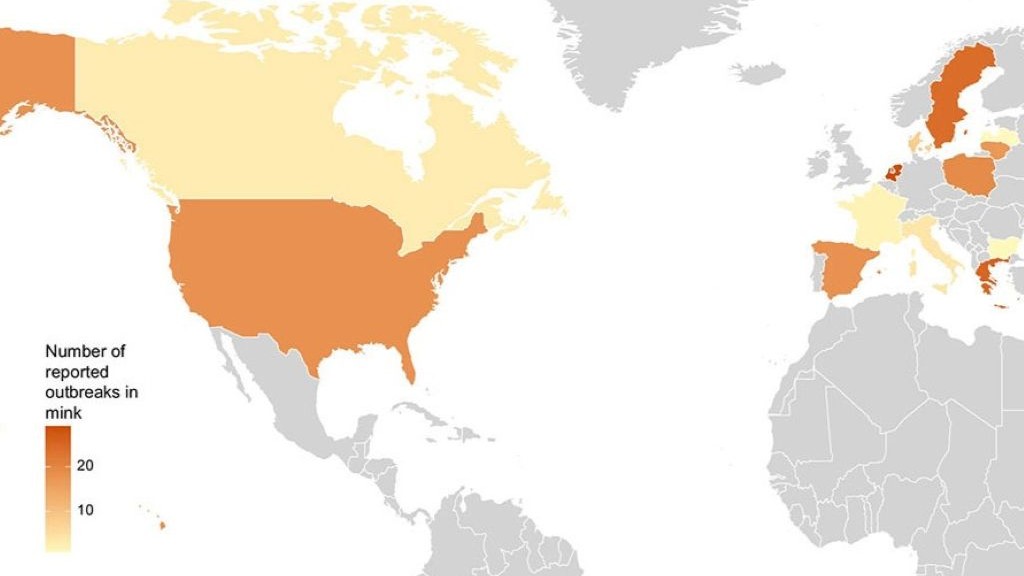
A study published earlier this month found that SARS-CoV-2 (the virus that causes COVID-19) continues to circulate in U.S. farmed mink, that mink can serve as "reservoirs" for the virus, and that the virus has spread from mink to other wildlife.
The 3-year study by researchers from Ohio State University, the National Institutes of Health, among others, along with the participation of Fur Commission USA, was the largest study to date of SARS-CoV-2 and the fur industry in the U.S.
During the study, researchers collected thousands of samples from mink on 18 farms in six states. SARS-CoV-2 was detected on 3 farms in two different states; 6% of mink on those farms tested positive.
The study also found that virus strains remained among mink long after they disappeared from the human population, a result the researchers called the study's most significant finding.
Finally, the virus was found to have spread from mink to white-tailed deer near one of the infected farms, a "rare instance" of SARS-CoV-2 transmission between non-human species (transmission could have involved escaped mink).
When FCUSA and fur farmers agreed to participate in the study, these were probably not the results they were hoping for, as it contradicts the industry's long-standing position that mink farming is not a public health threat. (Fur Commission USA received $363,954 for its part in the study.)
Researchers concluded that "active surveillance" is needed to monitor the spread and adaptation of the virus, especially since the infections they detected were in mink without noticeable symptoms. Currently on U.S. fur farms, testing and reporting is only done in response to sick or dead mink.
Mink farming is a public health risk. As long as COVID-19 is still circulating in humans, the virus will spread to mink, mutate and potentially pass back to humans or other animals, increasing the likelihood of a future pandemic.
Read the study, "SARS-CoV-2 Delta variant re-emerges in US farmed mink and free-ranging white-tailed deer in 2022–2023," here: https://www.nature.com/articles/s41467-026-75363-4.